Welcome to Micron.com, please Log in or Register an account to continue.








The opportunity and growth of edge AI



Memory and storage products for AI applications
Micron’s portfolio of power-efficient memory and storage solutions enables edge AI, from cars and phones to PCs and beyond.
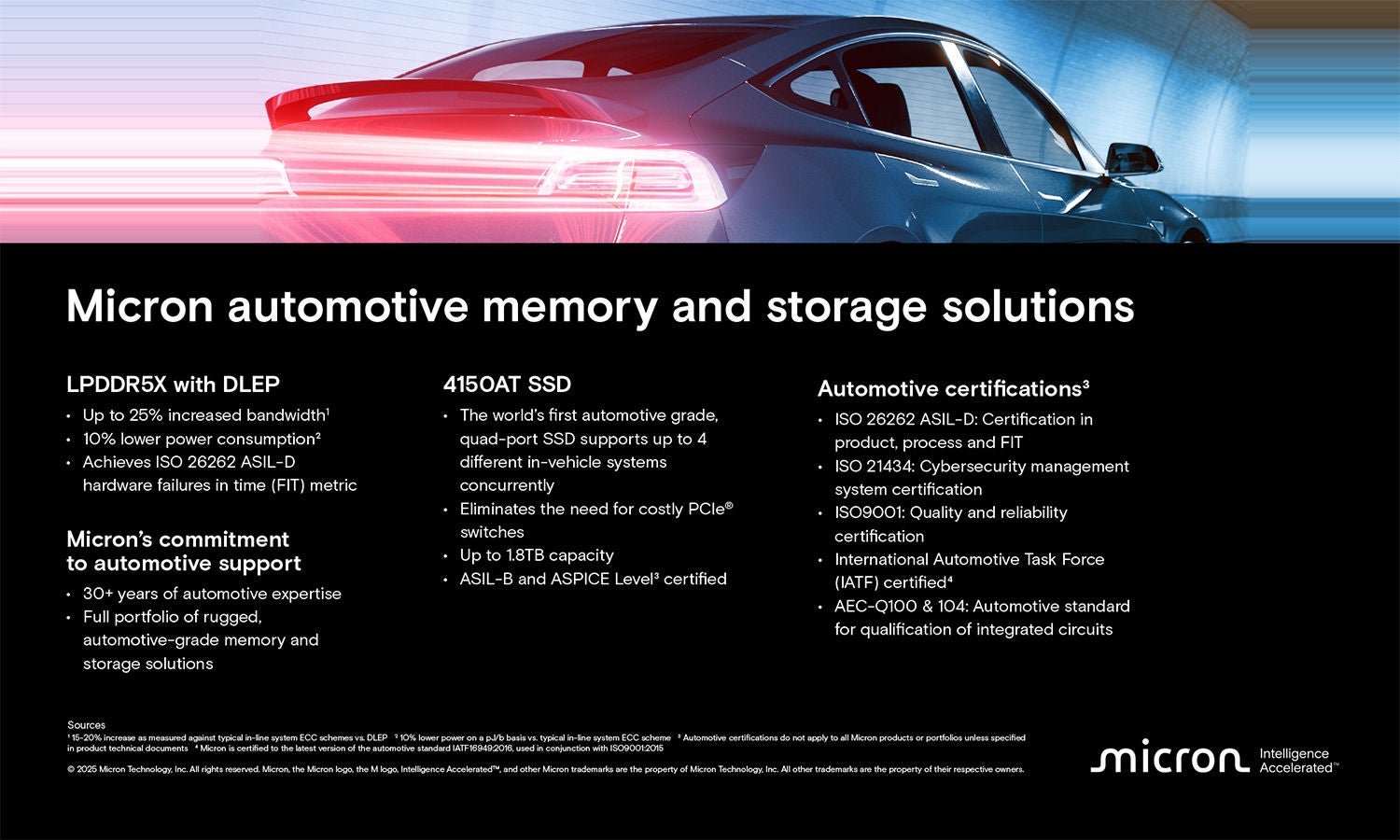
Automotive
Click on a hotspot to learn more or visit our Automotive page.
Personal computing
Click on a hotspot to learn more or visit our Personal Computing page.
Mobile
Click on a hotspot to learn more or visit our Mobile page.
We accelerate the transformation of data into intelligence




Frequently asked questions
Edge AI works by deploying trained AI models onto local hardware, where they process data as it is generated. Instead of sending data to a remote server, the device uses built-in compute, memory, and storage to analyze inputs with minimal delay and deliver immediate results. In many cases, AI models are trained in the cloud using large datasets and then optimized for deployment on edge devices for fast, on-device inference.
For example, a smart traffic camera can use edge AI to detect vehicles, pedestrians, or accidents in real time and adjust traffic signals without sending video to the cloud. In healthcare, edge AI can analyze medical images directly on portable diagnostic equipment, helping identify potential abnormalities while keeping patient data on the device. By processing data locally, edge AI helps reduce latency, improve reliability, and keep sensitive information private.
The key difference is where AI processing happens.
- Edge AI runs on devices close to the source of data, enabling real-time, responsive, and personalized experiences.
- Cloud AI processes data in centralized servers, where large-scale computing power supports model training and complex analysis.
Today, most AI systems use a hybrid approach. Data may be collected and acted on at the edge, while the cloud handles large-scale training and coordination. This distributed model improves speed, scalability, and efficiency across environments.
Edge AI brings several advantages by processing data closer to where it is created.
- Real-time responsiveness: By processing data locally, edge AI can analyze information and act in real time without the delays of sending data to the cloud. This reduces bandwidth usage, minimizes dependence on constant connectivity, and enables faster, more efficient decision-making.
- Power efficiency: Running AI closer to the data improves efficiency and lowers energy demand.
- Enhanced privacy and security: Sensitive data can stay on-device instead of being transmitted externally.
- Greater reliability: Edge AI runs reliably even in disconnected environments, enabling uninterrupted operation for mission-critical workloads.
- On-device fine-tuning: In some cases, models can be further tuned directly on the edge device using local data, improving accuracy for specific environments without sending sensitive data to the cloud.
- Scalable AI deployment: Distributing artificial intelligence (Distributed AI) across devices enables AI to operate across many environments.
Memory and storage play a central role in enabling edge AI because they determine how quickly and efficiently data can be processed on-device. Edge AI systems rely on fast, high-performance memory to access and process data with minimal delay, while storage ensures that large volumes of data can be captured, retained, and retrieved when needed.
Without optimized memory and storage, AI models cannot run efficiently at the edge. High bandwidth and low latency allow devices to make instant decisions, while power-efficient designs ensure these capabilities can scale across everything from smartphones to industrial systems. Together, memory and storage form the foundation that allows edge AI to transform raw data into actionable intelligence in real time.
Continue exploring AI with Micron