


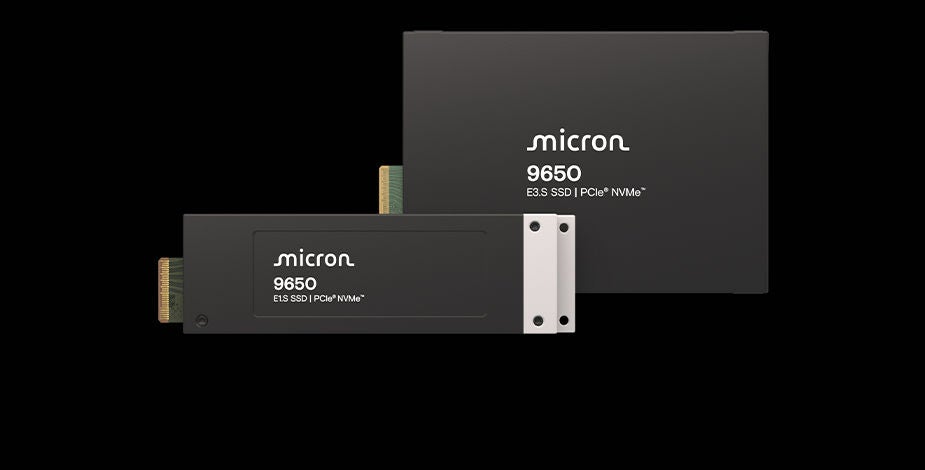
The Micron 9650 NVMe™ SSD is now in mass production, the first PCIe® Gen6 drive to achieve this milestone. With this landmark, the industry is at an inflection point, where high-performance storage is no longer optional and architectural decisions around data movement are fundamental to the success of AI workloads.
This is the story of how we got here, and where high-performance storage is going next. For most of the modern computing era, storage has been expected to do one thing above all else: stay out of the way.
Compute advanced. Networks accelerated. GPUs evolved into engines of unprecedented parallelism. And storage kept pace just well enough to avoid slowing everything else down.
That era is over.
Today, storage is no longer a background component of infrastructure. It is a determinant of system performance, efficiency, and return on investment. In an AI driven world where data must move continuously, predictably, and at massive scale, storage performance has become a first order design constraint.
Why PCIe® Gen6 matters
The transition to PCIe Gen6 represents one of the most significant shifts in I/O architecture in years. With bandwidth generally double that of PCIe Gen5, PCIe Gen6 removes a critical ceiling on how fast data can move between storage and compute. The Micron 9650 SSD enters the market as the world’s first PCIe Gen6 data center SSD, delivering massive performance increases compared to prior generations.
| Performance type | Micron 9650 | PCIe Gen5 SSD | Micron 9650 advantage |
|---|---|---|---|
| Sequential read | 28,000 MB/s | 14,000 MB/s | 100% higher |
| Sequential write | 14,000 MB/s | 10,000 MB/s | 40% higher |
| Random read | 5.5 MIOPS | 3.3 MIOPS | 67% higher |
| Random write | 900 KIOPS | 720 KIOPS | 22% higher |
With unmatched 28 GB/s throughput, the Micron 9650 dramatically accelerates AI training and inference workloads. During inference, high throughput is essential to enable real-time data access for large models, such as AI workloads with extended context windows and retrieval-augmented generation pipelines.
As AI systems evolve, data increasingly moves directly between accelerators and storage, minimizing CPU involvement. PCIe Gen6 performance drives this shift by providing the bandwidth headroom required for peer to peer data movement in next generation architectures.
Performance with efficiency
Historically, higher performance often meant higher power consumption. In today’s data centers, that tradeoff is no longer acceptable.
AI infrastructure already consumes a significant and growing share of global electricity, and energy availability has become a limiting factor for expansion. Any storage solution that improves performance but worsens energy efficiency simply shifts the bottleneck elsewhere.
| Workload | Micron 9650 | PCIe Gen5 SSD | Micron 9650 advantage | |
|---|---|---|---|---|
| Sequential I/O | MB/s per watt read | 1,120 | 560 | 2X better |
| MB/s per watt (write) | 560 | 400 | 1.4X better | |
| Random I/O | KIOPS per watt (read) | 220 | 132 | 1.7X better |
| KIOPS per watt (write) | 36 | 28.8 | 1.2X better |
This is why energy efficiency is a defining characteristic of our next generation storage. The Micron 9650 is engineered to deliver industry-leading performance, and strong performance‑per‑watt. At the same 25-watt power state, it delivers twice the performance of PCIe Gen5 drives, helping data centers extract more useful work from constrained power envelopes.
The Micron 9650 offers superior performance-per-watt compared to PCIe Gen5 SSDs, achieving better energy efficiency for both random reads and writes. Faster data transfers at the same power, result in lower total energy consumption, helping data center operators meet their sustainability goals.
This efficiency focus reflects a broader industry trend: Performance gains must now be paired with sustainability gains, or they will fail to scale.
Thermal reality: Why liquid cooling is moving to storage
As performance densities rise, thermal management has become a system wide challenge. GPUs moved to liquid cooling first, but storage is now following.
High performance PCIe Gen6 SSDs will operate in environments where airflow alone is often insufficient. The Micron 9650 supports both air-cooled and liquid-cooled configurations, recognizing that storage can no longer be thermally isolated from the rest of the platform.
Ecosystem enablement and AI workload performance
Over the past 18 months, Micron conducted extensive interoperability testing across the PCIe Gen6 ecosystem, paving the way for rapid adoption of the Micron 9650. Key milestones include:
- Interoperability validation:
- Live demonstrations at DesignCon, FMS 2025 and SC25:
Conclusion: A defining moment for high performance storage
The Micron 9650 represents a fundamental shift, from storage that tries to keep up to storage that keeps GPUs fed, removing bottlenecks, improving energy efficiency and enabling AI infrastructure to operate closer to its theoretical potential.
High-performance storage drives are no longer chasing compute. They are enabling AI performance breakthroughs. The Micron 9650 leads the way.
With the Micron 9650 now in mass production and being qualified by key OEM and AI data center customers, the industry takes a meaningful step toward a future where high-performance storage is no longer optional and architectural decisions about data movement are crucial to AI workloads.