





Every AI system helping researchers uncover new insights, every logistics network adapting to real-time conditions, every engineer using simulation to build better products — all of it runs on data centers that must simultaneously deliver extraordinary performance and operate with increasing efficiency. As AI moves from experimentation into production, from simple query-response into continuous, agentic systems that reason, plan and act autonomously, the demands placed on underlying infrastructure are growing dramatically.
Much of the industry conversation has focused on processors: the GPUs and custom silicon racing to keep pace with increasingly sophisticated AI workloads. But processors are only part of the story. The memory systems that feed those processors are equally critical, and perhaps less well understood. Memory determines how quickly data reaches the compute engine, how much of a model's working dataset can be kept readily available, and how efficiently a server uses every watt of power it consumes. The economics of AI infrastructure are increasingly shaped by how efficiently operators can turn power, cooling capacity and capital investment into usable compute, and memory is becoming one of the primary levers of that efficiency.
That is why LPDDR, a low-power memory technology long associated with mobile devices, belongs in the data center conversation. Once AI shifts from occasional training runs to continuous inference, power-efficient memory becomes more than a mobile design advantage. It becomes an infrastructure advantage.
Among the characteristics that matter most for modern AI systems, energy efficiency is becoming particularly important for inference and agentic AI workloads and is one reason LPDDR is finding a growing role in data center architectures.
The good news for data center operators is that memory innovation has never been more dynamic. From high-capacity server memory to low-power memory architectures and high-bandwidth memory designed for AI accelerators, the industry now has more tools than ever to match the right memory to the right workload. At the center of that evolution is LPDDR, purpose-built for the performance-per-watt demands that inference and agentic AI place on modern infrastructure. For years, LPDDR was associated primarily with mobile devices, where maximizing performance while minimizing power consumption was essential. As AI infrastructure becomes increasingly constrained by power and cooling, the same design principles are finding new relevance in the data center. In many AI environments, efficiency is now an integral part of the performance equation. Understanding why that matters is key to understanding how AI infrastructure is evolving.
Think of it like the interstate highway system
To understand why memory architecture matters so deeply in modern AI systems, consider an analogy rooted in something familiar: the interstate highway system supplying a large, around-the-clock manufacturing plant.
The plant is the processor — powerful, productive, but only as effective as the raw materials arriving at its loading dock. The highway network is the memory system — the infrastructure that moves data from where it lives to where it's needed, as quickly and efficiently as possible.
In the early days of the plant, the solution to increasing output was straightforward: build wider interstates and let the trucks drive faster. That worked well for a long time. But as the plant grew more complex — running hundreds of simultaneous production lines, handling constantly shifting inventory, operating 24 hours a day — throughput alone was no longer enough.
What the plant really needed was a smarter logistics network: yes, wider highways; but also more highways, closer distribution centers and more efficient vehicles. And just like no single logistics plan works for every factory, no single memory technology serves every workload. Modern AI infrastructure works the same way.
Why inference and agentic AI change the equation
The early era of AI was defined by large, episodic workloads — training runs and batch processing where some inefficiency was tolerable. That calculus has changed. Inference at scale and agentic AI systems run continuously, interact with users in real time and must respond in milliseconds. And they're deployed not just in hyperscale data centers but across distributed cloud regions, edge locations and enterprise environments.
This shift has real implications for memory:
- Inference workloads are memory-bound, not just compute-bound. In a pure inference workload, the model is already trained; what matters now is how quickly its parameters, context and intermediate states can be loaded, accessed and refreshed — over and over, for thousands of simultaneous users.
- Agentic systems compound memory pressure by maintaining longer conversational contexts, executing multi-step reasoning chains and coordinating interactions with external data sources — all at once.
- Latency becomes a user experience variable. In agentic AI, slow responses don't just frustrate users — they can break the coherence of an interaction. Memory architectures that support fast, consistent responses are directly tied to product quality and user satisfaction.
What memory characteristics matter most for AI data centers?
In the context of modern AI infrastructure, four memory characteristics have become strategically important: bandwidth, energy efficiency, capacity and responsiveness. Different memory technologies address these differently — and that is precisely why cutting-edge AI servers rely on multiple different memory technologies.
- Bandwidth: Delivering data at scale
Even the most powerful processor can only work as fast as data arrives at its door. In AI systems, memory bandwidth — the rate at which data moves between memory and compute — determines how often the processor sits idle waiting for its next instruction.
When bandwidth is insufficient, processors spend time waiting for data rather than performing useful work. Architectural approaches that increase parallel data movement help maximize overall system throughput.
- Energy efficiency: Doing more with every watt
AI systems are increasingly expected to operate continuously, serve more users simultaneously and process larger volumes of data. In that environment, energy efficiency is not simply about reducing power consumption. It is about maximizing the amount of useful work infrastructure can perform with every watt available.
Memory technologies that improve performance-per-watt allow servers to process more requests, deliver faster responses and support more AI-powered experiences from the same infrastructure footprint. As AI usage grows, efficiency becomes a way to expand what infrastructure can accomplish.
- Capacity: Keeping more data available
Capacity determines how much data can remain readily accessible to compute. As AI models grow larger and maintain increasingly complex working states, keeping more data close to compute reduces interruptions and helps maintain performance.
- Responsiveness: Speed that users experience
In AI systems, responsiveness determines how quickly the system can surface the specific data a model needs, when it needs it. This matters especially in real-time AI applications where user experience is measured in milliseconds. Memory architectures that keep active datasets readily accessible and minimize retrieval delays contribute directly to end-to-end system responsiveness — including metrics like time-to-first-token that are increasingly used to benchmark AI serving quality.
The point is not that one memory technology should serve every AI workload. AI infrastructure needs a more specialized memory hierarchy, with HBM, DDR5, LPDDR and fast storage (SSDs) each serving different system needs.
A portfolio built for the full spectrum
Today's data center memory landscape is a complementary ecosystem where different technologies serve different roles based on workload requirements, system architecture and deployment context. Micron's portfolio is designed to serve this full spectrum.
HBM sits at the top of the performance stack, purpose-built for the most demanding AI workloads, including large-scale training and high-performance inference. Because it's stacked alongside the processor, it provides the greatest bandwidth of any existing memory. Micron's innovative process technology and design have helped our HBM hit industry-leading power efficiency.
DDR5 is the proven, high-capacity cornerstone of server memory — broadly compatible, battle-tested across enterprise and cloud environments, and optimized for the wide range of general-purpose workloads that continue to run alongside AI. When AI agents execute database tasks and requests, they're often sending them to these traditional servers. DDR5's role is not diminishing; if anything, the scale of AI infrastructure expansion is driving continued, substantial demand for DDR5 capacity.
LPDDR occupies a distinct and increasingly strategic position in AI architecture. While DDR5 remains the preferred choice for many general-purpose and capacity-intensive server workloads, LPDDR is particularly attractive in inference-heavy environments where performance-per-watt is a primary design consideration. Engineered from the ground up for high performance and exceptional efficiency, LPDDR delivers bandwidth-per-watt characteristics particularly well-suited to continuous AI serving and agentic workloads. As AI moves from model development into real-world deployment, inference workloads operate continuously across thousands of users and systems. That makes performance-per-watt an increasingly important factor in infrastructure design.
SOCAMM2 modules deliver multiple LPDDR packages in a serviceable form factor designed specifically for servers, bringing LPDDR's efficiency and density advantages to a broader range of data center architectures while supporting the reliability, availability and serviceability (RAS) characteristics expected in enterprise environments.
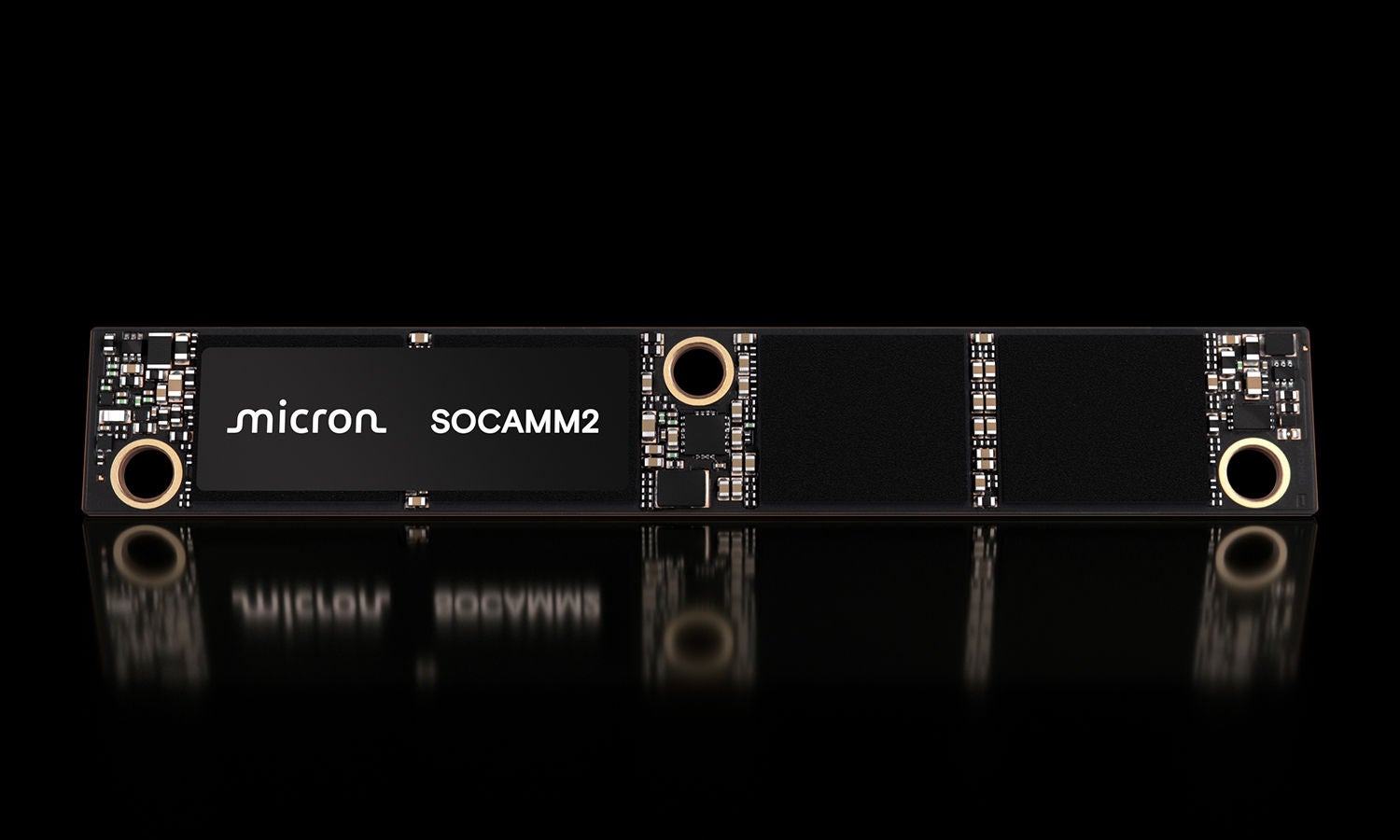
Together, these technologies form a memory portfolio capable of serving the full spectrum of AI workloads, from the most computationally intensive training jobs to the continuous, latency-sensitive inference serving that defines the agentic AI era.
Micron's role: LPDDR leadership and depth across the full portfolio
Micron's position in this landscape reflects decades of investment across memory technologies, deep engagement with hyperscalers and technology leaders, and a manufacturing footprint built to support AI infrastructure at global scale.
That breadth matters. AI systems require multiple memory technologies working together, and customers need partners capable of delivering performance, efficiency, quality and long-term supply across the full stack. From DDR5 and HBM4 to LPDDR and SOCAMM2, Micron's portfolio is designed to support the diverse requirements of modern AI infrastructure.
Micron's leadership in low-power memory is particularly relevant as power efficiency becomes a defining constraint of AI. Years of investment in LPDDR architecture, manufacturing and standards development have helped position the company at the forefront of a technology that is finding new relevance in the data center. The introduction of SOCAMM2 is one example of that evolution, extending the efficiency advantages of LPDDR into a modular form factor suited for a broader range of server architectures.
The bigger picture
The transition to AI-native infrastructure is still in its early chapters. As agentic AI systems become more capable and operate continuously and AI native applications continue to scale, power efficiency is becoming one of the defining constraints of modern infrastructure.
Systems that run continuously, serve large numbers of users simultaneously and respond in real time cannot be built around a one-size-fits-all memory strategy. The economics of operating AI at scale — measured in power consumption, cooling capacity, infrastructure utilization and total cost of ownership — make memory architecture a competitive variable, not simply a technical choice.
In that environment, LPDDR is taking on a more strategic role. Originally developed for efficiency-sensitive environments, its performance-per-watt characteristics align closely with the requirements of modern inference and agentic AI workloads. In a landscape where attention is naturally drawn to processors, the memory architecture feeding them efficiently may prove equally consequential.
Memory is only half the story
While memory sits at the heart of AI system performance, it is only one part of a broader infrastructure equation. In the era of inference and agentic AI — where systems must continuously retrieve, reason over and act upon vast volumes of data — storage plays an equally pivotal role. The ability to move data efficiently between persistent storage and active memory tiers determines not just how fast an AI system can respond, but how cost-effectively it can operate at scale. The most well-designed memory architecture in the world is only as capable as the storage infrastructure feeding it. For a deeper look at the infrastructure constraints shaping AI data centers, read our related piece on liquid cooling and power efficiency.